
From the Archives: When The Truth Doesn't Matter
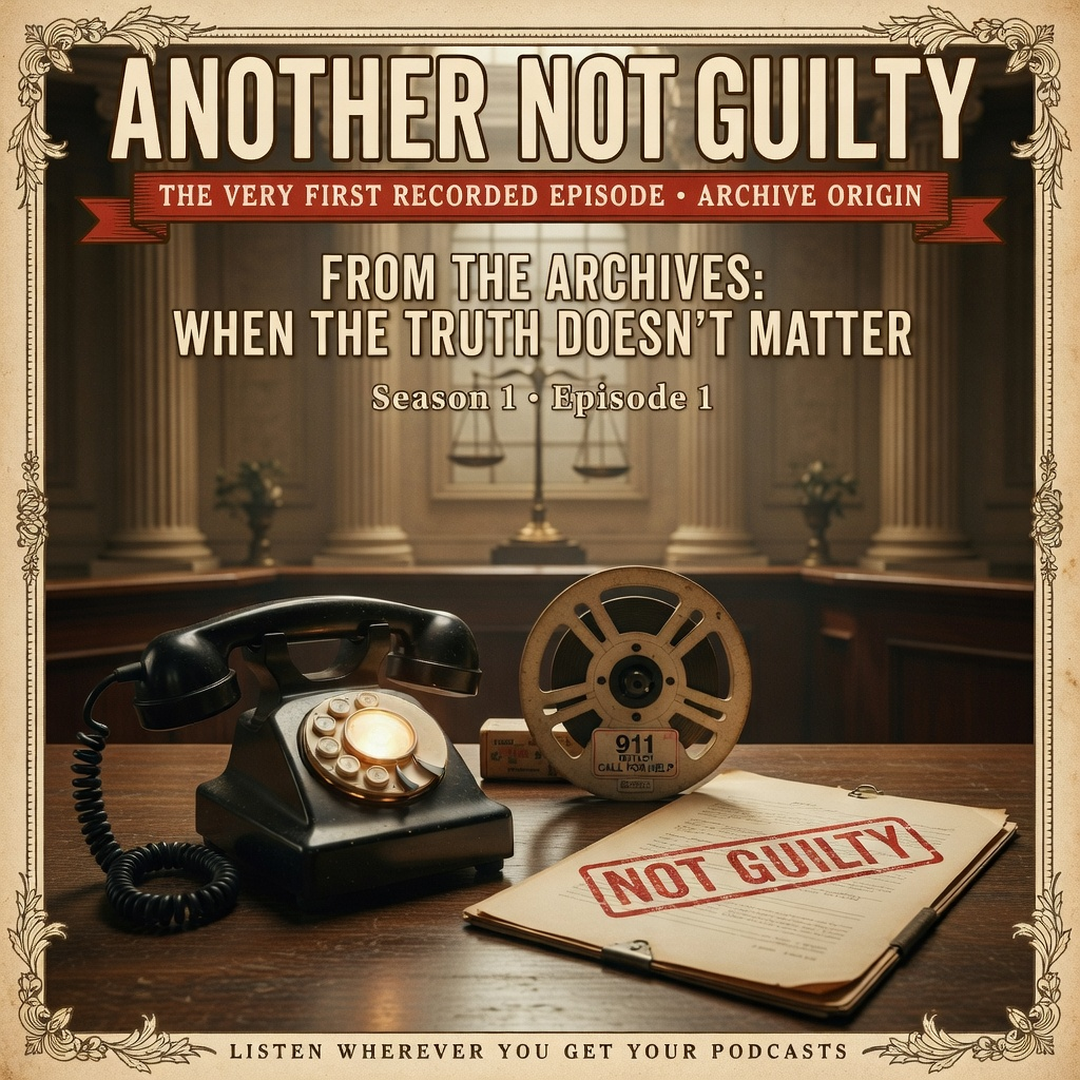
This is where Another Not Guilty began. Originally recorded as Season 1, Episode 1, this episode was pulled from the public defenders' vault, remastered with clean audio, and returned to the docket.
Public defender John tells the story of a DUI case that began with a domestic violence call and became a fight over what prosecutors and police were willing to learn about the truth.
When a woman called 911 for help after an assault, the police response turned her into the defendant. Her lawyer challenged that version of events and fought to show what actually happened when the prosecution insisted that investigating the truth was “not my job.”
The case ends before a jury that took less than two hours to reach the right verdict, proving that when twelve everyday citizens hear the full story, common sense still wins.
Episode guide
Key points
- John describes a DUI prosecution that began after his client called 911 seeking help during a domestic violence incident.
- The client was arrested after moving into the driver's seat while waiting for police to arrive.
- The defense challenged the gap between the distress call and the prosecution's account of the incident.
- The discussion examines the prosecutor's obligation to investigate and pursue the truth before taking a case to trial.
Trial or closing note
The jury returned a Not Guilty verdict in under two hours, rejecting the prosecution's attempt to turn an assault victim's plea for help into a criminal conviction.
Full transcript
Here at Another Not Guilty, we appreciate your support. Don't forget to subscribe or follow us. And please visit our website at anothernotguiltypod.com. Without further ado, here's this week's episode of Another Not Guilty.
He had a moral and legal obligation to find out what the actual truth was before he prosecuted people for crimes. And, you know, asking him, don't you want to know what happened? Don't you want to know the truth? To which he responded, that's not my job.
She was abused by her husband previously, abused by her husband on the night of the incident, disrespected by the police officer, dragged to the station, arrested, breathalyzer, test administered. When you're in the moment, you just, I don't know, you never have faith. You never think it's going to work out.
This is why juries are so important because everybody else is indoctrinated into the system somehow. They have a role to play and they're a repeat player. You know, to them, it's like another day at work.
Welcome to Another Not Guilty. I'm David. I'm Nikhil. We're public defenders here to share the untold stories of the criminal justice system.
Objection! That assumes there's justice in the system, which there ain't. I prefer calling it the American criminal system.
Okay, stories from the American criminal system from the forbidden point of view, also known as the point of view of the defense, the one that the man doesn't want you to know about.
These stories are about the many not-guilties we public defenders get on a daily basis in an unjust criminal system with the deck stacked against us.
We got a defender with us today who has successfully won one of those cases, got himself a nice not-guilty. Why don't you introduce yourself?
Hello, everybody. My name is John and I am a public defender and I'm here to tell a story about one particular trial that I had.
Nice. So you got a not-guilty, huh?
I did. All right. One.
You've had several not-guilty. I know. You know, I've seen you around. I know you got some skills. So what was this case about?
So this was a DUI case, which is a driving under the influence case, but that's not really what it was about.
In this particular case, my client was a woman who was pulled over by law enforcement late at night after calling 911 for law enforcement to respond to the scene.
And the reason that she had called 911 is because during her 911 call she reported being the victim of domestic violence at the hands of her boyfriend.
As she's calling 911 for help, her boyfriend, who was previously in the car with her, leaves the scene.
And by the time the law enforcement agent gets there, my client is the only person left, at which point, ultimately, she is arrested for driving under the influence because she is sitting in the driver's seat of a car at the time that the law enforcement officer gets there.
So, hold on. So when the law enforcement officer gets there, is the vehicle stopped already?
Yeah, yeah, yeah. I will. I'll back up a little bit.
Okay.
So what happened was she was in the passenger seat of her car and her boyfriend was in the passenger seat of the car, or excuse me, the driver's seat of the car.
And so they were driving together, and there were some things that had happened previously in the night.
Based on the information I had at the time, what it looked like was her boyfriend was out at a house late night partying.
She came to the house, potentially unannounced, and he did not know that she was going to be there, which he found very upsetting for whatever reason.
So at that point in time, he becomes physical with her, drags her to the car, throws her in the passenger seat, and starts to drive away.
Oh, that sounds like a kidnapping to me.
That's what you would think, right?
Yeah, right.
So as they're in the car together, she is understandably distraught, and she calls 911 after, you know, having some amount of physical interaction with her boyfriend in the car.
So as she's calling 911, he freaks out and pulls the car over to the side of the road, jumps out and runs away.
She climbs over the center divide of the car, gets in the driver's seat, stays on the phone with 911, and starts just driving in circles around the block, waiting for the police to arrive.
And when the police arrive, she's frantic, which is reflected in the 911 call.
You know, in the call, you can hear her kind of crying and screaming and exhibiting various emotions, you know, in a heightened state.
Basically, when the police get there...
It's a domestic violence call.
It's a domestic violence call.
She's calling the police to say, "My boyfriend has hit me.
I need help."
And the 911 operator is talking to her, saying, "Where are you?"
And she freely admits that she's in the car, and the 911 operator is saying, "You know, we need you to stop, stop moving so the police can find you."
And she is driving relatively slowly in a circle around the block.
And the 911 call ends with her saying, "I see the police.
I see the police.
They're here."
Was she like, "Thank God.
Thank God the police are here."
I don't remember if it was like that.
My heroes are here.
I'm a victim of domestic violence.
I was just kidnapped.
Yeah, yeah, so...
Thank you for coming through, 911.
I guess the policy is for the 911 operator to stay on...
Until the actual police make contact.
Exactly.
Stay on the call until the police make contact.
So the call is like seven minutes long or something like that.
And there's various pauses and silences.
Some of it's incoherent.
But it sounds, you know, it sounds very genuine.
You know, she's saying how she's been struck and then kind of fluctuating back and forth at certain points saying how much she cares about the boyfriend.
Oh, so very typical, like psychological profile of someone who's been abused, who has like a, you know, they love their spouse or partner and...
Correct.
...been abused by them and, you know, just confronting that conflict or that dilemma of this person who I love has physically abused me.
Yeah.
So she gets the 911 operator on the line, kind of heat of the moment, calls for immediate assistance, doesn't know what to do.
And then as the call progresses, you can hear her emotions kind of fluctuate back and forth.
She never hangs up or anything.
She stays on the line, but, you know, she's saying, you know, I love him, but, you know, this is what just happened in the moment.
So the police show up, she gives him a description of the assailant and then the police go after him.
Uh, no.
So...
I mean, it's seven minutes away, so he's just walking somewhere, right?
Yeah.
So the police make contact with my client.
Uh, an officer arrives and my client stops, admittedly is in the car and the car is in motion and, um, pulls over when, when the police are there.
The officer gets out.
My client, um, you know, there's two different descriptions, you know, according to my client, she gives, you know, a detailed description of what's taking place.
According to the police officer, she's difficult to understand in the moment.
Um, police officer would later testify that, you know, she seemed, uh, frantic and she seemed, um, excited and upset, you know, that she was crying.
None of that was in dispute, but, um, so the officer, I guess at a certain point, you know, is having a conversation with her and then does something which, you know, I think everybody can, can imagine taking place in various contexts.
Just kind of stops the conversation that's going on and says, ma'am, have you been drinking?
Hmm.
And so kind of cuts off my client, you know, mid sentence when she's explaining this scenario, um, and says, you know, have you been drinking?
And so to which my client who, uh, admittedly has been, but not to a crazy amount or anything like that, um, you know, kind of says like, yeah, you know, I had something to drink, but that's not really the point.
You know, um, I'm trying to, I'm trying to talk to you about something else right now.
Um, and then, you know, the cop kind of doubles down and says, you know, at that point, um, you know, once there's been an admission, if you're in the driver's seat of vehicle and you say you've had anything to drink, you know, a police officer will kind of go into an automated mode at that point a lot of the time.
And so robots.
Yeah, exactly.
Have you been drinking?
Yes.
I'd like you to come with me.
I need you to do some tests.
And so that's the end, at which point my client essentially completely shuts off.
And this is where humanity ends and the system takes over.
Yeah.
And so at that point she says, no, you know, I'm not doing your tests.
What, what are you talking about?
That's I, why would I ever have to do that?
You're here to help me.
I called you and now you want me to put my finger on my nose.
Absolutely not.
Yeah.
So.
And, and just so I guess from my own edification, I mean, kidnap is a felony offense, right?
I mean, that's kind of a, that's a charge that if, if they found this guy who ran out of the car and, you know, and these allegations were true, I mean, this guy is facing prison time.
Yeah.
That's a strike, right?
I mean, this guy, I mean, this is a serious offense.
This is not just some, you know, some, you know, drunken lovers quarrel where there's maybe, you know, some mutual pushing and shoving.
A kidnapping is a very serious offense.
Yeah.
We dedicate a lot of resources to going after people like that.
That's what you would think if you were to compare the, you know, relative moral wrongdoing between a just over the legal limit drunk driving offense and a kidnapping offense.
I think the natural assumption would be that, uh, the law enforcement agencies would prioritize the kidnapping.
Yes.
But unfortunately that's not what happened here.
So let me ask you this.
Why did you end up with the case?
How did you get the case?
So that's an interesting, uh, question.
And I think also plays into everything that's going on here.
Um, I got the case actually after it was a couple months into the proceedings.
So essentially another attorney had been handling the case up until that point in time.
Um, at which point, um, you know, I wasn't present for any of those hearings or court dates or anything like that.
But that attorney discovered at a certain point that they had represented the boyfriend on a separate criminal matter in the past, which created a conflict of interest for them.
Cause they could not represent both the boyfriend and the girlfriend who was Mike now was going to become my client.
And so her case, uh, was passed on to me, kind of given to a fresh attorney who had had no prior experience working with the boyfriend in the past.
Uh, and at that point, um, you know, I inquired of the other attorney, like, I know you represented this person, but you know, what are they, uh, you know, what was the case that you had with them?
What's going on because it might be relevant in the future.
If this person comes in to testify, you know, you need to know about their backgrounds.
And, um, as it turned out, when you ran, uh, the boyfriend's name in the court computer system, uh, the case that he was previously represented on by that attorney was in fact a domestic, a felony domestic violence complaint, where my client was the complaining witness or victim.
So not only is my client now told the story to the police on the night she was arrested for DUI that she was being abused by this person, but about two years prior to that, um, he had actually been formally arrested and charged with domestic violence, uh, perpetrated against her, the, the very same victim.
And it's my understanding, let me ask you this, that usually when someone is a victim of domestic violence and there's like a conviction, um, that a restraining order is issued.
So in this case, um, was there a valid restraining order, uh, keeping, uh, uh, the boyfriend away from your client at the time of, uh,
Right. There was not, in fairness, there was not.
So what had happened with the prior case was that, um, at some point in the prosecution had, um, announced unable to proceed on that case.
And that's all the information I have, um, because that's all that was provided in the court minute order or court docket.
So he wasn't convicted then.
He was not convicted.
He was arrested.
He was charged.
Um, it was scheduled for a, what's called a preliminary hearing.
And on the day of the preliminary hearing, um, the case was dismissed by the prosecution.
And the reason stated was that they were unable to proceed with the prosecution for whatever reason they deemed on that day.
Got it.
So, um, you got the case and then, uh, so tell us what, like the, I mean, leading up to why this case went to trial, what were the plea negotiations like?
What were you looking for?
What was your client?
Right.
So, uh, understandably, you know, after speaking with my client, she wasn't looking for anything other than a dismissal, um, and an apology for putting her through, uh, what she went through, which consisted of, um, being subjected to a, uh, you know, a breathalyzer test, arrested, put in jail for about two or three nights and having to pay bail to get out again.
So, um, I sort of explained my situation to the district attorney and, um, the, the, the major complication in the, uh, case was that the police officers report, um, which led to the filing of the DUI charge by the district attorney's office was just so incredibly bare of relevant facts from the evening that negotiating with the district attorney was, was very difficult.
Yeah.
Because they, they read the police report and they take it as true.
And in the police report, there was no mention of a boyfriend.
There was no mention that my client had, um, given a name or a description.
Or called 9-1-1.
Well, they had to concede that she called 9-1-1 because, um.
What was the description of the police report for the 9-1-1, the dispatch call?
The dispatch call was domestic violence.
And just, just like kind of like a more summary, not detailed.
Correct.
She called, we responded to a dispatch call of domestic violence and then I arrested this
woman for DUI.
Yeah.
So it just gave like a one line at the top that was, I responded to such and such area on such
and such date and time because there was a report of domestic violence.
Um, and then it just immediately jumped into, um, upon contacting the person who was identified
as the caller, I made the determination that they had been, uh, consuming alcohol while
driving a vehicle.
And then just launches into the driving under the influence.
So robot talk, a lot of robot talk here.
Robot talk.
Yeah.
Yeah.
So it was a great, great boilerplate, just no, no complete failure to, you know, acknowledge
anything that my client.
Any context or the circumstances.
Correct.
The context.
So it was actually a really long and drawn out process with the prosecutor's office to try
to try to figure this out because, um, sort of my first move was to, um, go to the prosecutor
and say, uh, you know, here is my client's version of what happened, you know, in a very
bare born, uh, bare bone format.
And I gave them the name of the boyfriend and I told them at this point in time that I
was requesting any criminal background information on the boyfriend to see if he did in fact have
any other convictions that I didn't know about any other instances of domestic violence.
Um, and at that point, the district attorney just turned to me and said, no.
And I was confused at this point in time.
And I was like, wait, you know, what do you mean?
No.
And they said to me that they only had a legal obligation to provide me with the background
information, um, on potential witnesses or actual witnesses in the case.
And I said, well, right.
Well, he was present on the night that all this happened.
So he's a potential witness to which they said.
To which they said, that's your version of the events.
My police officer never even wrote down his name.
So I'm choosing to believe my police officer's version of events.
And I'm not calling him as a witness.
So I don't have to give you any of his information about his prior criminal proceedings or prosecution
for domestic violence or anything of the sort.
But as a starting point in negotiations, um, that was not the best beginning to, um, you
know, what we thought were fair negotiations and a fair outcome for the case.
So you're trying to be reasonable.
I would like to think so.
I always feel like they just, you know, they just see that the person's innocent or.
Yeah.
And I especially thought that at that point in time, I was like, oh, we have this prior, um,
instance of alleged domestic violence where this person was arrested and the district attorney's
office themselves had filed a criminal charge against him.
So they must've at least at one point in time found some validity to that claim.
So, you know, talking with the DA now who, you know, didn't know anything about the prior
incident was not involved with that, but talking to him now and saying, look, your office filed
this charge.
Like you, you're aware that this happened.
And to which his response was, well, like, I don't know.
I personally don't know anything about it.
And I'm, and I'm refusing to look into it because I don't plan on calling that person as a witness.
So I don't have to tell you anything about it.
This seems to be like the major shortcoming.
I think in Brady evidence, right.
Is that we give so much authority to the prosecutor to determine like what's exculpatory, how to,
how they have to determine what's exculpatory when they have to give it to us.
Like, so basically, I mean, this prosecutor can stick his head in the sand and goes, ah,
I don't think your defense is exculpatory because it's not in my police report.
So I don't have to give you any evidence.
Culpatory evidence is evidence that tends to show that the accused or defendant is innocent
of the charged crime.
Under Brady versus Maryland in 1963, the Supreme Court of the United States ruled that the prosecution
and police are required to turn over such evidence to the defense.
And it put me in a really, you know, awkward position at that point in time, because in my mind, I felt as if I then had to prove the existence of this human being, you know, the boyfriend.
I had to prove to the DA that he was a real person who existed, who had a prior allegation of domestic violence.
And, you know, they have the resources to look into this, but the burden sort of fell to me.
And because the police officer had also failed to even mention his name or description of him, which my client was telling me she absolutely positively gave to the police officer on that night and said, here, you know, he actually, I, you know, I've been, I've been misstating the entire time.
He was her husband, so they were legally married.
Oh, wow.
And so, you know, this is a formalized relationship where there would be, you know, court documentation of their relationship with one another.
You know, they've, they've signed a certificate.
They've, in fact, been to court over, you know, certain things about their relationship in the past.
And so I was just kind of flabbergasted that, you know, he, the prosecutor didn't seem inclined to even, you know, look into this.
And, and absent from any, absent any, you know, obligation to turn over exculpatory evidence, which, you know, I would say does exist.
It just seemed like a, like a, like just someone being purposefully obtuse.
And so I, you know, the, the first day we kind of talked about it, or maybe it was the second or third court appearance.
It just, it just ended in a shouting match between me and him essentially in the middle of the courtroom where he was explaining to me how it wasn't his legal obligation to turn over these things.
And I was in turn responding that he had a moral and legal obligation to find out what the actual truth was before he prosecuted people for crimes.
And, you know, asking him, don't you want to know what happened?
Don't you want to know the truth to which he responded?
That's not my job.
Wait, I mean, they are held to a higher ethical standard than defense attorneys, right?
Um, I mean, the, the jobs are different.
They're different.
They have a different job, you know, in there.
Why do you think he was being such a dick?
You know, I think it's one of these problems where the relationship between the police and the prosecutor is so sacred, you know, they have to remain on such good terms with each other.
Um, that the ability of the prosecutor to question anything that a police officer has written in a report is, is, um, severely limited is what I would say.
Like blasphemy.
Yeah.
Because they can't, you know, these are the people that they rely on to come into court and to testify on their behalf.
And if you ruin that relationship somehow, or you accuse them of, you know, at worst, you know, at the very least, what you have here is a police officer who is exhibiting some kind of indifference, you know, just a complete indifference to their job, to their moral obligations.
Um, at worst, you have someone who's actively falsifying a police report by omission, material omission.
Yeah.
I mean, it's not just like material omission.
Yeah.
Not a small detail.
It's I'm not including this because I want you to burn for DUI.
My client's entire defense and statements to the police officer from that evening were omitted from the report.
So it depends how you look at it.
You know, did she make something up?
That's not true.
No, she reported facts.
You know, my client had had something to drink.
She gave her a breathalyzer test.
The breathalyzer test gave a result of a point one zero percentage of alcohol, which the legal limit is point zero eight.
She was driving a car.
So there was that.
But then, you know, never mentioning at all any of the reasons why she happened to be driving the car on that evening, which to me did see around the block, slowly around the block.
Yeah.
While calling nine one one while seeking assistance for kidnapping.
Yeah.
While driving around the block while on the phone with nine one one and not disconnecting the nine one one call until the police officer actually arrived.
So.
All right.
So you've you've realized that you're not going to get anywhere with the district attorney.
So this case is going to go to trial.
Right.
Mm hmm.
So what are you doing to prep for trial?
So I mean, this is it.
Um, so now, as I was saying before, I was in this kind of awkward situation where I felt like I had to I had to validate my client's story to the district attorney.
Right.
Because he's he's come to me and he said, I think you're essentially he's saying to me, I'm trusting my police officer who would have recorded all of the important information and didn't.
And therefore, what your client is saying must not be true.
So because the police officer didn't write anything in the report, you know, the D.A. is operating under the assumption that my client has not has made up this imaginary husband who was with her on the night abusing her.
So the D.A. lives in a world where everybody's happy and go lucky.
There's this battle of good versus evil.
The police are good.
Mm hmm.
And everything that the defense attorney or defendant claims must immediately always be looked with suspicion and skepticism.
Yeah.
Yeah.
Kind of like, of course, she would say something like that.
You know, she's trying to get out of a DUI.
OK.
So and she can't dispute the fact that there was alcohol in her bloodstream or that she was driving.
You know, those aren't disputed.
So she's making up this excuse to try to weasel her way out of it is essentially what he's saying.
So I you know, these people are married.
Right.
So my client obviously has his name and his contact information and she knows where he lives and how to get in touch with him.
So now I'm in this awkward position where I have to reach out to him to ask him about how he abused my client on the night of her DUI.
So that I can provide this information to the district attorney to at the very least, let him know that, you know, I'm not lying to him to prove to him that I'm not lying to him, that my client isn't lying to me.
So, of course, as you could imagine, when you try to contact somebody and ask them to admit to committing domestic violence, they're understandably hesitant to do so.
So as it turns out, we actually were able to get in touch with him.
And one of the investigators who was working for me found him and he gave a somewhat mixed statement.
Right. He says, like, yeah, I was there. Yeah.
You know, I was with her, but I didn't hit her, which is, you know, what what you would expect him to say.
So he said kind of some good things and some things that, you know, weren't as my client was portraying them.
He corroborated it, though. He's least at the scene. You put him at the scene.
Yeah. So he says he actually says that he admits that they were in the car together.
He admits that he was driving. He admits that they were fighting.
But he then says, as I was driving the car, my client, the woman was slapping him.
So he decided to pull the car over and get out and leave the scene.
And he says that he stood in the middle of the road like the median.
There's a median divider in the middle of the road.
And he says he stood in the median of the road about 20 feet away and watched my client get arrested for DUI.
That was his statement. So then so then I the statement is recorded.
It's written now. I give it to the prosecutor and I'm kind of like, see here, you know, here you go.
Here's your, you know, smoking gun, if you will.
Like I've proved that this is a real life human being with a date of birth and an address and a phone number.
And he has even gone so far as to corroborate that he was present at the scene on the night my client was arrested,
thereby proving that your police officer was negligent in their duties and failed to record his presence or at least record my client's statement that he was present.
To which the district attorney says, well, he says he didn't hit her.
So I don't care if he was present.
I still think your client is lying about him hitting her because he, in fact, says the opposite, that she was striking him.
So, you know, once again, you know, this Alice in Wonderland is like you failed to prove to me because this person didn't admit to beating his wife.
That it must have not happened because, of course, he would have admitted it.
Yeah. Yeah. And the sort of the most at this point in time, the most egregious thing to me is that, you know,
if you ever talk to a prosecutor or somebody who works for law enforcement in, you know, like a domestic violence unit of any kind,
they'll they'll talk to you day and night about the habitual nature of these events.
Right. When you have two people who are in a relationship and one of them is abusive towards the other, it's never a single event.
That's you know, they'll talk all day about the cycle of violence and how it's never a single event.
And here we have an instance where this person has, while not a conviction, a prior arrest for domestic violence, a new allegation.
Felony domestic violence, a new allegation of domestic violence and a 911 call where, like we talked about before, the person calling is speaking in terms that like any prosecutor normally would be capable of understanding,
which is simultaneously asking for help while excusing the behavior of the offender and exhibiting remorse for the defender, you know, irrational remorse somehow.
So I was just kind of struck by how, um, obtuse they were being. Yeah.
Just their failure to accept the things that most of the time they're more than willing to talk to me about.
You know, when, when I'm representing a client who's accused of domestic violence and the tables are turned, you know, they, they'll tell me about this stuff all day long as if it's the gospel.
What do you mean? What, why do you think that there's just like this double speak?
Like why is the prosecutor when your client's accused of domestic violence, then we subscribe to these theories of, you know, the cycle of violence and how, you know, they're corroborative, um, 911 calls.
And then when you're, when you're trying to use it in your defense of your client, but then it's dismissed.
Why, why do you think that there's that double speak from the prosecution?
You know, I think it's just once the prosecutor files a charge, they have a really hard time letting go of it.
It's like a freight train.
It's like a freight train.
It's like a dog that's got their teeth on a bone and they don't want to let go of it.
Um, you know, because they don't want to undo what their colleagues have done.
So essentially, at least in the courthouse that I work in, you have a system where one district attorney will file a charge and another district attorney will actually be the person in charge of prosecuting it, of taking it to trial.
If it goes to trial and of working up the case.
So all the time, when you go to talk to them, they will say things to you, which I find kind of amazing, um, because it's not rooted in like law or morals or logic, logic or ethics.
They'll just say to you, I, I just can't step on my colleagues toes.
So, I mean, the system seems to be compartmentalized to, to encourage this lack of confrontation between them.
Like saying, you know, one day to another day, Hey, I think you made a mistake.
They are even to the cops or whatever.
They just will compartmentalize this so much that, you know, everybody's unwillingness to, to confront somebody with you made a mistake or, you know, you're unethical son of a bitch.
Right.
Like then, because we're all trying to play so nicely and get along, you know, the defendants are screwed over.
Especially in an instant like this, where I think, you know, in the jurisdiction where I practice most of the time, the district attorney who is prosecuting a misdemeanor DUI case, which is what this is, is going to be one of the, um, lower level, lower level attorneys.
Yeah.
So the person who's filed the charge is more senior to them.
The person who is supervising them is more senior to them, obviously.
And they don't want to be, they don't want to be the DA who goes to their boss and asks for a reduction or dismissal.
They don't want to be that fish swimming against the school.
They don't want to appear soft.
They don't want to appear like they have compassion.
Well, they don't want to go to the, they don't want to go to their boss who in all likelihood has risen through the ranks to become a supervisor because they are.
Tough on crime.
Yeah.
They have a tough on crime stance and they have, um, earned a reputation as somebody who gets convictions or something to that effect.
And when you're a newer employee, I think it's your worst fear over concerns for your own job security and your own professional development.
You know, it's your worst fear to go, even if you believe that something should be done, it's your worst fear to go to your boss and say, I want to dismiss this case.
Because if they disagree with you at that point in time, you know, your upward mobility within the department is, is, is squashed, or at least that's what they're afraid of happening.
So let's get back to the, we have two political, we have two political, uh, crimes here, DUI versus domestic violence.
How'd it go?
Who won?
Well, um, or is there any more leading up to trial you want to share?
Yeah, I'll share a little bit more.
Um, I'm not sure I'd use, I'm not sure I'd say anybody won here.
I think everybody came out a little bit worse at the end of it.
But, um, but yeah, so, um, good day in the criminal justice.
Yeah, yeah, exactly.
But, um, so my, my pretrial negotiations with the district attorney kind of carry on for a couple of weeks, you know, of arguing back and forth and me being upset and them refusing to budge.
Um, and eventually at a certain point, um, I don't know, I guess I, perhaps wore them down to, to some extent.
And the district attorney handling the case comes back to me and says, okay, okay, I've, I've talked to my boss and I think we can figure this out.
And I'm like, okay, great.
They're going to dismiss the case.
It took a couple months, but we finally got through to them with this and, you know, they're going to dismiss the case.
And so I'm talking to the district attorney and she says, I've talked to my supervisor and we're willing to let your client plea to a wet reckless with DUI terms.
And so, you know, to my client, you know, this is fake offer, which is, yeah, which is not a real thing.
You know, if you're my client and you're in the position of, you know, you're, you feel as if you're being wrongfully prosecuted for a crime.
You didn't commit or, you know, you, you were reaching out to the police for help in a time of turmoil and they turned on you and now you are.
And you went to jail.
You went to jail.
You failed out.
You put out bail money and.
Exactly.
So my, you know, I'm, I have a legal obligation to tell my client what the offer is so that they can make an educated decision about what they would like to do.
If I don't tell my client the offer, I'm not doing my job.
So I tell my client the offer to which she like understandably, you know, lays into me about how that's not an offer and how she wants to go to trial.
She's a smart one.
Cause that's definitely not an offer.
A DUI or a wet is still a, you still have to do alcohol program.
Yeah.
It's still two points on your driver's license.
It is literally everything the same, except for semantic difference of 90 days maximum exposure.
There are some minor differences.
There are some minor benefits, but if you're coming from the position that my client was coming from, you know, there's no difference.
You know, you're still being prosecuted.
You still get a criminal charge on your record.
It still has the ability to mess up your employment prospects and your life generally.
So, you know, to which point, you know, at which point we just say, no, you know, that's, I guess we just have to go to trial.
So this is how we ended up going to trial.
And so at the trial, and there was one other thing.
I'm not sure if it's even important to mention here, but there's one other thing.
We actually had a hearing prior to trial to make a determination about whether the police officer had withheld information from us.
And we lost, which I anticipated because, you know, the standard for things like that is that the police or the prosecution have to consciously withhold.
You know, they have to be aware that they have something that defense needs and they have to choose not to give it to them.
And the judge was actually sort of sympathetic.
And he, after the officer was done testifying and left the courtroom said that he wasn't going to agree with me and he wasn't going to, you know, dismiss the case on those grounds or anything close to it.
But he just made an offhand comment at the end that it would appear that the officer was highly negligent in her duties.
But unfortunately, negligence is not the standard.
I mean, again, I'm sorry, but so you had a hearing before the trial.
Right.
Right.
To argue that the case should be dismissed because the officer probably didn't record the name of the witness.
Correct.
So the officer, my argument at that point in time was that the officer, going back to what we said before about an inability to collect evidence at a later date.
You know, my argument to the court was that the officer at that point in time had an obligation when responding to a domestic violence 911 call to investigate domestic violence.
At least acknowledge at some point during her investigation that she was there for domestic violence, you know, to at least write in the report what my client was saying and then talk about why it was unfounded or untrue and why she moved on to a DUI investigation, which was absent up until that point in time.
I sort of just did that to make a point in many ways, you know, but this is when I was still trying to negotiate with the D.A.
So I kind of wanted them to see, you know, firsthand because a lot of the time they don't even talk to the officers.
They just read the written report and they won't follow up and they'll just say, well, this is what it says in the report.
And they don't even bother to contact the witnesses until they arrive to testify.
Is this is a motion you calendared before the trial?
Correct.
OK, so the trial, it still hasn't even sent out for trial yet.
Has not been sent out for trial.
OK, so now you're doing a motion to dismiss.
Uh huh.
You bring in the officer so the D.A. can hear how horrible this officer is.
Correct. Yeah.
To which the judge says, you know, I'm not getting rid of the case.
That's overstepping my boundaries in this particular instance.
But it would appear that the officer has been highly negligent in their response to this call for service.
Oh, so the judge's chickenship, basically.
Yeah.
You know, won't go ahead and do what's right.
So you basically put a clear case and they hide behind some legal semantics that it doesn't rise to the level.
Because what office just like, you know, what officers going to get up there and say, oh, you know what?
I did consciously hide evidence from the defense because I was more concerned with the DUI than I was with the domestic violence offense.
Right.
So it's never going to that.
You're never going to get that magical piece of evidence.
The amount of evidence you need to win that motion is absurd.
Functionally unobtainable.
Yeah.
OK.
So it's just like it's just like the your defense witness admitting to your investigator that he beat your client.
Yeah.
It's just like unattainable like like that.
Yeah.
So I guess, you know, when viewed in the best of terms, you could you could maybe say that the judge was leaning on the prosecutor at that point in time to suggest what he really thought.
Yeah.
So he's not going to do it.
But, you know, maybe winking at the prosecutor, hinting at them that if they wanted to do it, you know, he'd probably be OK.
Yeah.
He wouldn't argue over it.
So under the most generous terms, that's that's what I could assume.
You're being so kind.
Yeah.
Thank you.
Thank you.
I don't know.
I don't know.
I don't know.
So it's so then it goes.
So it goes to trial.
The crux of my argument to the judge at that point in time is that if this case goes to trial, it's no secret here that I am going to be arguing that my client was under some form of duress or was acting under some necessity when she drove the car, which would excuse her legally.
Duress is a threat of harm made to compel someone to do something against their will or judgment.
Necessity, a defense that permits a person to act in a criminal manner when an emergency situation, not of the person's own creation, compels the person to act in a criminal manner to avoid greater harm from occurring.
Right.
And so to prove that she was under that duress or exhibiting or like under that necessity, we need to show that what was, you know, that she was being abused, like she says she was being.
One way to do this would be to perhaps have pictures of her physical state from the night when this took place, which is another thing that the officer neglected to do.
You know, the trial goes about according, you know, like how you would imagine it would.
So the police officer testifies that, you know, gets up and testifies that at the time she was there, she didn't notice any indications of domestic violence.
She didn't see anybody else on scene.
You know, she even said some sort of like half-hearted stuff about how she looked around the block, you know, turned her head and didn't see anybody and determined that my client was not being truthful and moved on to her DUI investigation.
And she, she what gave a, gave a nod to, she looked, she scanned the street.
She looked, she looked up and down the block.
She didn't see anybody.
And that means that.
Yeah.
She called out, Hey, anybody perpetrate domestic violence?
Please step forward.
Yeah.
And so I asked it during that point, you know, did you call for backup?
Did you make a perimeter?
Did you, you know, did you broadcast the name of the individual?
And if not, why did you broadcast a description of the individual?
And if not, why?
And so she said, you know, she explained that away by just saying no one ever gave me that information.
So I couldn't tell anybody.
Oh, so she, now she's claiming that.
So she gets up on the stand and she lies basically.
Well, yeah.
Did she contradict her testimony from the motion?
No, no, no.
Her testimony was consistent.
Her testimony, what, you know, was relatively consistent, either saying I couldn't understand
what the woman was telling me, or she didn't tell me that.
So, you know, essentially, um, disavowing the fact that she had information that she did,
then did not choose to use.
And so we go to trial and, you know, the cop says what the cop is going to say.
My client gets up and tells, you know, a story about, like we were talking about in the beginning,
basically a recounting of the entire night, um, and gets to talk about how, um, you know,
the night began and how the domestic violence began and where she was and how she was in the
passenger seat first.
Um, and you know, the, the funny thing is, is that, you know, normally the district attorney
did not play the 911 call during their case.
So the district attorney presents their case first and they just asked the cop, you know,
did you respond?
And then, you know, the answer was yes.
And what did you respond to?
I responded to a domestic violence call.
But then when my client testified, we chose to play the entire call, which is, you know,
seven minutes of hysterics essentially about this event.
And so.
I must have went over real well with the jury.
I'm sure.
I w I would assume so.
Yeah.
Um, because it was, you know, it's a live recording of what's taking place in the moment.
So there's no time to fabricate.
There's no time to make things up.
You know, you're just getting someone's emotions as they're coming.
And it was pretty clear from the call that those were, you know, real or raw emotions.
Did the prosecutor try to limit the plane of the 911 call?
No, no, no.
I mean, you know, for, for what it's worth, the prosecutor just kind of let the chips fall
where they may.
Um, you know, she argued her case.
She objected to me sometimes, but, um, for the most part, pretty much everything came out.
Um, and so my client testified, um, the husband boyfriend did not testify.
He did not make it to court surprisingly enough.
Um, yeah, yeah.
It was shocking.
I know.
Um, we, we, yeah, he didn't, he did not come.
Can I ask you a question?
Yeah.
Yeah.
So, uh, prior to the trial starting, what was, uh, what was jury selection?
Like was the D the DA doing the typical DUI voir dire?
Yeah.
The DA was almost, it was interesting to watch because it was, you know, like I, you know,
in my mind leading up to this point, you know, we had been very hardline, you know, saying,
we just want a dismissal.
We want a dismissal.
And, you know, in my mind, I was like, they, you know, I don't, what are you, how are you
going to, I, I didn't know how they were going to explain that away.
Right.
Like how they were going to, you know, my client was seemingly a very sympathetic defendant
and there would seemingly be proof to this effect via the 911 call.
So I didn't know how they were going to try to explain that away.
Um, and they, you know, as it turned out, they didn't try to explain it away.
They just flat out ignored it.
So yeah, they just didn't, in voir dire, they didn't address it.
They got up and talked about how this was a domestic violence incident.
They stuck to the police officers report.
Right.
So they, they just said a police officer responded.
What about your voir dire?
Did you bring up domestic violence or what did you bring up?
I, it's funny cause we, we definitely just came at it from two different angles.
Right.
So it was almost like having two prosecutors because she was prosecuting a DUI case and I
was prosecuting a domestic violence case.
So she did her DUI voir dire to see who would be good in a DUI trial.
And I got up and I imagine, you know, had some overlap at the very least with what a prosecutor
would normally do in a domestic violence trial where they were actually trying to prosecute
for domestic violence.
So it was sort of trying to find people who would be sympathetic to, um, a woman in my
client's circumstances.
Yeah.
So that was your case.
You just put your client up and then 911 call, right?
Yeah.
I mean, it was interesting cause I essentially ignored everything they did because we were
conceding the blood alcohol level and conceding the fact that my client drove.
So there's really nothing to say about those things.
What about the day you're going to do FSCs, field sobriety tests?
No, she was so mad at the police officer that, um, she refused to do them.
So she told the, she, you know, at that point in time when she was first getting arrested
and like saw what was happening, was it, you know, like, Oh my God, this is really turning
around on me.
What is going on?
Um, you know, she flat out, flat out refused.
You mean to say that after being kidnapped and abused by her husband, she didn't want
to voluntarily agree to count backwards or touch her nose six times.
My nose is bruised officer.
I can't, it's bleeding.
I can't really touch it right now.
Okay.
So then the case went to arguments.
So did the, did the, did the prosecutor ignore your necessity slash duress of defense?
Well, we should argument.
Let's first ask.
I mean, did you get the yes to judge for the necessity and duress instruction?
I did ask.
Yes.
Cause that was your defense.
And obviously she was being a victim and been kidnapped.
So she testified, I'm sure to the elements of those defenses.
So there was evidence of that actually happening.
So real evidence, there was real evidence via my client's testimony.
And the 9-1-1 call.
And the 9-1-1 call.
As much as we want to complain about the prosecution and their hardline stance and they can't dismiss
a case, this and that, I mean, that's why we have judges for checks and balances.
Right.
Yeah.
Because they're neutral arbitrators and the district attorneys, you know, they are interested
in the pursuit of justice, but occasionally, you know, they don't necessarily, uh, have that
as their foremost priority.
Wow.
You are very, being very kind to certain stakeholders.
Well, I was just, you know, I'll say they're, you know, the way they behave in court, I think
varies from their mission statement.
Their mission statement is the pursuit of justice.
But, um, due to various incentives, structural incentives, um, I don't think that's what always happens.
So good thing we have a judge, right?
Right.
Yeah.
So the judge denied the duress instruction.
Shut up.
Yeah.
After, after the pretrial motion is dismissed.
Yeah.
Were you clearly made it, I mean, obvious that you were going to go with this defense,
you're opening your defense evidence, you were not allowed to argue, huh?
Yeah.
I was, I was very clear, you know, it was very open, you know, because I, to me in this instance,
there's no sense hiding the ball.
There's no strategic advantage to, you know, like a sneak attack or anything like that.
Everybody knew what was going on at all times.
Oh, what?
Okay.
I'm, I'm sorry.
I'm incredulous.
Um, what, on what basis was this instruction left out?
Left out.
So the judge denied the instruction, right?
So there's, you know, uh, unfortunately I'm forgetting the exact language of the instruction.
There's, I think seven, six or seven elements that you need.
And the judge, um, told me and told my client, told everybody that, um, you know, in order
to grant the duress instruction, essentially you have to have no other available options to
you other than breaking the law to protect yourself from physical harm.
Okay.
Right.
So I was like, yeah, I know that's my client had to run away.
So she got in the car and ran away.
This is what I'm thinking in my mind.
Yeah.
But in the judge's mind, things were working a little bit differently.
So the judge said, my client did not have to drive the car.
She could have locked the doors and sat in the car or she could have also got out of the car
and run in the opposite direction of her husband.
On foot.
On foot.
Oh, okay.
On foot at night.
And this is, yeah.
After being kidnapped.
This is a random neighborhood.
There's no, you know, she, the car is pulled off of the freeway onto the first intersection
off the freeway, at which point this guy bails and runs away.
So she's also still out there.
He's still out there.
According to his statement, he is watching my client interact with the police officer from
the median behind the bushes or something.
But, and, but you're, the judge thinks that she, the alternative would be just to flee
on foot.
Well, there's also no evidence of that because my client did not know where he was specifically
like was not in his sight line, right?
Or he was not in her sight.
Well, that's what I mean.
I mean, this guy's out there somewhere.
He's out there.
Yeah.
Lurking.
Okay.
From a legal point, and this is I guess for our legal listeners, isn't that issue something
to be decided by the jury if that was accurate or not?
The trier of fact.
Fact.
A trier of fact or finder of fact is a person or a group of persons, usually a jury, who determines
facts in the legal proceeding, usually a trial.
To determine a fact is to decide from the evidence whether something existed or some event
occurred.
Isn't that really like, there's some evidence of it and if the jury wants to reject that argument
and say, hey, she could have ran away or if she could have locked the doors and that's
for them to make a decision.
Yeah.
I mean, you would hope, right?
Right.
I mean, that's what it sounds like to me.
I'm just a lawyer, you know.
So if the judge denies your duress instructions, does that mean you can argue duress as your
defense to the jury?
No.
It means you are legally prohibited from arguing duress.
So the jury is not going to receive that instruction.
So the jury is not going to be, at the end of the trial, the judge reads all of the necessary
instructions to the jury kind of like a how-to on doing your job.
You know, the lawyers have finished their cases, they've finished their closings.
I'm going to tell you how the law works and then you're going to go back into the deliberation
room and make your decision.
So, you know, I was hoping that the judge would give this instruction saying, you know,
when somebody is under duress, it's possible because it's not a definite like you were
saying.
The judge would give them instruction that it's possible for them to find a duress excuse
here.
And so it's not directing them that that's what happened or anything of that nature.
It's saying here are the seven elements.
Like if you find all seven of these, you may find that the defendant is not guilty for
reason of duress.
It just seems so absurd to me for the judge to cut you off of the knees like that at an
argument after allowing you to get into the factual basis of domestic violence that caused
the duress in the first place.
Well, it's kind of an interesting, like that's why I said in the beginning, we were very out
in the open about it because you need to, in order to have the instruction granted, you
need to provide evidence that all of the elements are present.
So some evidence, not some.
Yeah.
Yeah.
But you have to, what I mean is you have to talk about it during the trial.
Basically.
Yeah.
So we had to, you know, we were up front with the judge and we said essentially, you know,
you know, because one of the things the prosecutor did object to was some of the background information,
right?
Like what happened in the car before the police got there, you know, that's not relevant
to the DUI.
Um, what happened at the house where my client met her boyfriend, that's not relevant to the
DUI.
The district attorney was trying to exclude all that elements and just saying, you know,
we need to look at this at a moment in time.
It's a DUI.
We only need to talk about the elements of the DUI.
To which I had to then say, but we will be seeking a duress instruction.
So here's why all this was relevant.
So the judge allowed it to come in, you know, kind of pending her decision because she had
to hear the evidence herself.
And then at the end of the day, um, said, I'm not giving that instruction.
So at that point in time, I was a little deflated.
And I was like, you know, we've argued with the DA, we've argued with the cop, we've argued
with the judge and, you know, just nobody is, is cutting us any slack here.
No one's cutting us a break.
And now I can't even argue to the jury, you know, what I have been hoping to do the entire
time.
Okay.
So you don't get to argue.
So what do you get to say?
I mean, I, I'll be real.
If I was in your shoes, I wouldn't just be standing up there.
Uh, kind of just being like, yeah.
Cause we've, please don't vote guilty for my client.
Cause we've conceded.
She's drunk by the league in terms of the legal limit.
Yeah.
She was driving in terms of every definition of driving.
And so I, yeah, I was, I was, I was.
I argue that the punch to the face, uh, that sort of affected the breathalyzer or.
I could have, I could have, I should have.
But, um, yeah, so I'm just kind of, I'm just, I'm in my head, you know, my wheels are turning
and I'm like grasping at straws here.
I've organized my whole closing, like assuming that I would get this instruction and I'm going
to point out to the jury why all seven elements are present.
And so then I'm just reading the instruction for the DUI again, you know, kind of like trying
to trigger something, you know, think of anything that I can argue.
And, you know, essentially what I ended up saying to the jury was why would she have done this?
You know, like, cause for every crime you have to intend to do it.
There's a basic intent, you know, requirement.
Um, and so you have to have, you know, like bad thoughts.
You have to choose to do a criminal act.
And so essentially what I just argued to the jury was highlighting that one word and saying,
you know, yeah, willful, willful, that she willfully did this, you know, that she intended
to do this and asking, you know, and asking them like, is that what happened?
You know, what do you think she woke up in the morning or left the house and decided that
this is what she was going to do with her evening.
And at every step of the way, you know, every second of the hours preceding the event, you know,
there's no way she could have possibly decided to do this.
She was dragged along.
You know, she's, she literally, you know, this is not a figurative statement.
She was literally dragged along.
So how could you force into a car?
Yeah.
Wait.
And I mean, I'll be real.
I mean, I feel like I've tried to argue this before and I feel like some sharper DAs would
object and say it's kind of outside the purview of what, what willful actually means.
And yeah, maybe a judge might cut you off too, but did they just let you argue that?
They just let me talk.
And so at this point, you know, I'm also kind of fuming cause I'm like, I've been denied
every request I've made throughout this entire process.
So I'm just going to try to harp on the human elements of this event and pray that somebody
on the jury is feeling sympathetic.
And as it turns out, um, they were feeling sympathetic.
How long did it take?
How long was the deliberations?
Um, it was somewhere between like five and 10 minutes.
No.
Yeah.
Wow.
So did you, when it buzzed that fast, did you, did you feel like it was not guilty?
It was at the end of the day, you know, when the courtroom was about to close.
And I went back to my, I walked out of the courtroom after, you know, the judge put the jury
in the deliberation room and gave them their instructions.
I walked down to my office.
And when I got to my office, I got a phone call to come back up with, with, because the
jury had a verdict.
So I think as a defense attorney, you're always assuming the worst, you know, and you, you're
scared for your client and you feel, you know, you're, you're upset, like they're upset.
And, you know, you, you're just apprehensive, you know, you want to do well for your client.
And you're worried that people don't see what you want them to, or don't agree with you somehow.
And so that's how I was feeling at the time.
And then, you know, in, in retrospect, you know, you know, now I look back on it.
And I'm like, yeah, of course, like, how were they ever going to convict this poor woman?
This is a poor woman who talked about how she was abused by her husband previously abused
by her husband on the night of the incident, disrespected by the police officer, dragged
to the station, arrested, breathalyzer, test administered, you know, of course, of course,
you know, like the people are going to find something wrong with this.
But when you're in the moment, you just, I don't know, you never have faith.
You never think it's going to work out that way.
Because everybody you've been dealing with up to that point.
Had had no faith and was trying to cut you off at every moment.
Every, you forget, you know, and this is why juries are so important because everybody else
is indoctrinated into the system.
Somehow they have a role to play and they're a repeat player, you know, to them, it's like another
day at work.
And you forget when you get 12 people who aren't exposed to this kind of stuff on a regular basis,
that they're going to look at it with a fresh lens.
And, you know, it's, it's just amazing to me that, you know, for 12 people who heard the
facts from both sides, that, you know, it was a relatively easy decision when it had taken
months and months of arguing and negotiation to get the district attorney to offer a wet
reckless.
So, so I don't know.
So, yeah, so it was a happy ending, sort of.
And the reason I said before is that nobody wins is because the judge assessed trial costs.
Which means that my, despite the fact that my client got a not guilty, she was required
to pay $1,200 to the court for the privilege of having a trial.
Wow.
The privilege of proving her own innocence.
Um, and, um, yeah.
And then at the end, you know, the, the, the funniest thing to me, not funny, a saddest thing
to me is that the district attorney who, who tried the case came up to me.
I forget if it was like that.
I think it was the next day, you know, cause we, we work together and we see each other
somewhat normal regularly, um, came up to me and said, you know, something to the effect
of, you know, um, you know, can I be honest with you?
I think that was the right decision.
Sometimes you just have to let a jury hear a case, you know, to which I, you know, I thought,
no, you don't, you, you could have dismissed it.
You don't, your whole role is you get to do what's right.
Yeah.
You're the prosecutor.
You are a filter to what reaches the jury.
I can't dismiss cases.
I don't have that ability as a defense attorney, you as the prosecutor decide what to prosecute
and what to dismiss, what's worth it and what isn't.
And so I, you know, it's just kind of, it, to me, that statement at the end, you know,
just a total dereliction of, you know, your duties, just, you know, a complete misunderstanding
of what you're actually there to do because I would never agree with the fact that innocent
people should be required to go to a jury to prove their innocence.
You know, you think that there are some checks and balances as we were talking about earlier
that would help prevent both, uh, from like, I mean, even from like a purely economic perspective,
right?
Like why are we wasting so much time and effort when the evidence, um, that she was innocent
was pretty apparent.
Yeah.
There are some instances where there's a gray area where there are conflicting stories,
you know, and to me, this was not one of them.
This one seemed pretty clear cut from the get go.
And it seemed like a, an unwillingness to, to, to think, to critically think about what
had taken place or just care or care.
Yeah.
Right.
Like, cause what happens, you know, you don't care, you know, you still argue, the district
students still argue to the jury for a conviction and what if they do, you know, would you feel
bad afterward?
I don't know.
I don't know.
All right.
Well, um, good job, John.
Thanks.
Thank you.
That was a victory for justice.
A victory, a small victory.
You make us defenders proud.
Thank you.
Thank you guys.
Thanks for tuning in to this week's episode of another not guilty.
Shout out to Daniel Mark, creator of A and G's original theme music and our audio engineer,
Chris Adams.
And guess what?
We have another not guilty story coming your way next week because we public defenders
fight injustice every single day in the American criminal system.